



-
Date:2026-01-13

-
Page View:78

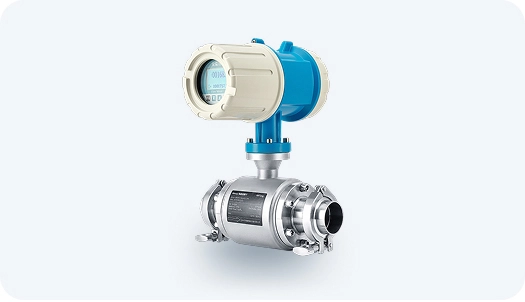
Digital water flow meters are essential devices for measuring water flow in a wide range of applications. One of the key advantages of digital water flow meters is their ability to display real-time data. The digital display allows users to monitor flow rates instantly, enabling informed decisions about water usage. Digital water flow meters also offer features such as data logging, which can record flow volumes over a specific period of time. They provide accurate data that helps with tracking and managing water consumption. Whether in residential, commercial, or industrial settings, understanding the different types of water flow meters is crucial for selecting the one that best fits your specific needs.
Digital Output of Flow Meters
Digital water flow meters can output flow data in several ways. Some of the most common types include:
Pulse output: This output generates a series of pulses proportional to the flow rate. By counting the pulses, the total volume of fluid passing through the meter can be calculated.
4–20 mA output: This method outputs a current signal that represents the flow rate and is widely used for continuous flow monitoring. For details, refer to the 4–20 mA flow meter specifications.
RS-485 or Modbus output: These are communication protocols that allow the flow meter to transmit data to a computer, PLC, or other devices.
Wireless output: Some flow meters are equipped with wireless capabilities, enabling data transmission via Wi-Fi, Bluetooth, or other wireless protocols.
These different output options make it easy to integrate digital water flow meters into various systems andapplications, simplifying fluid flow monitoring and management.
Electromagnetic Water Flow Meter
Steam Vortex Flow Meter
Types of Digital Water Flow Meters
The most popular digital water flow meters include rotameters, turbine water flow meters, electromagnetic water flow meters, vortex flow meters for water volume measurement, positive displacement flow meters, differential pressure flow meters, Coriolis mass flow meters for water, and ultrasonic water flow meters. The following sections describe the operating principles, key features, and typical applications of each type of digital water flow meter.
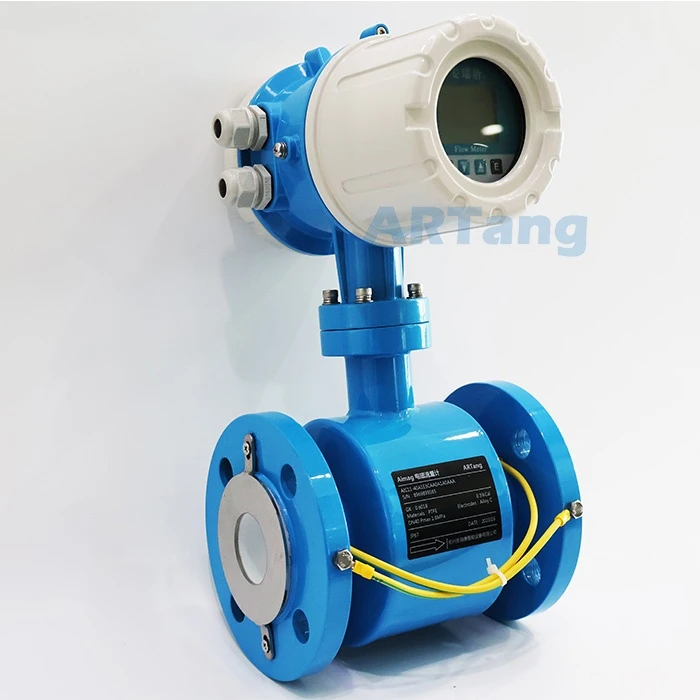
Electromagnetic Digital Water Flow Meter
An electromagnetic flow meter is designed based on Faraday’s law of electromagnetic induction and is used to measure the flow of conductive water.
Advantages: No moving mechanical parts, low pressure loss, and suitable for corrosive liquids such as acids and alkalis.
Limitations: Only applicable to liquids with a conductivity of ≥5 μS/cm; not suitable for oils or pure water.
Electromagnetic flow meters are widely used. In addition to measuring the volumetric flow of general conductive liquids, they can also measure highly corrosive fluids such as strong acids and alkalis, as well as slurries, pulp, and similar media. They are extensively applied in industries including petroleum, chemical processing, metallurgy, light industry, papermaking, environmental protection, and food processing, as well as in municipal management, water conservancy projects, and river dredging applications.
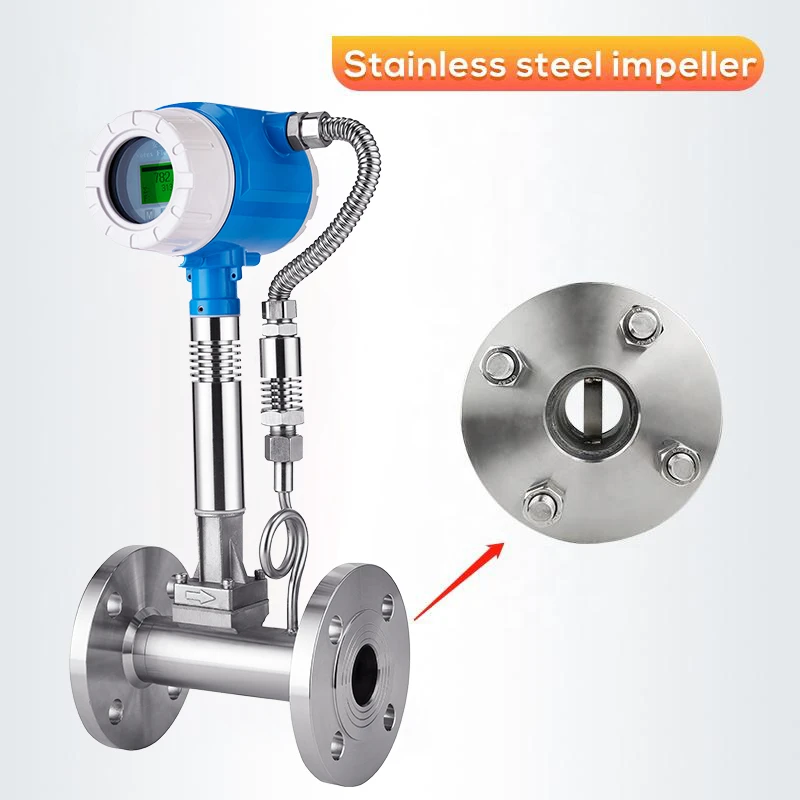
Vortex Digital Water Flow Meter
A vortex flow meter is a device that measures water velocity and flow rate using the vortex shedding principle. It is suitable for small to medium flow measurements and features a simple structure, fast response, and high reliability. Vortex flow meters are widely used in heating, HVAC, and chemical industries.
Wide turndown ratio: Covers a flow range of 1 to 100 L/min, adapting well to fluctuating operating conditions.
Low maintenance: No moving mechanical parts, strong resistance to fouling, and long service life.
Medium compatibility: Suitable for clean, low-viscosity liquids (such as water, acid and alkali solutions, and light oils); not suitable for fluids containing particles or with high viscosity.
Typical Applications
Chemical process control (e.g., acid and alkali solution blending)
Thermal energy metering in municipal heating systems
Environmental wastewater discharge monitoring
Ultrasonic Digital Water Flow Meter
An ultrasonic flow meter measures flow by detecting how a water stream affects ultrasonic beams (or pulses). Like electromagnetic flow meters, ultrasonic flow meters have no obstructions inside the pipe, making them non-intrusive flow meters. They are especially well suited for solving challenging flow measurement applications and are ideal for high-flow measurement in large-diameter pipelines.
Non-contact water measurement: Clamp-on sensors are mounted on the outside of the pipe with no need to cut the pipeline.
Zero contact, zero leakage, zero blockage, zero pressure loss.
Color display for clear visualization: A high-resolution color screen clearly shows instantaneous flow, setpoints, and totalized flow, making operation simple and efficient.
Typical Applications
Flow monitoring in municipal water supply networks
Leak detection in oil pipelines
Measurement of clean fluids in the pharmaceutical industry
Coriolis Mass Flow Meters for Liquids
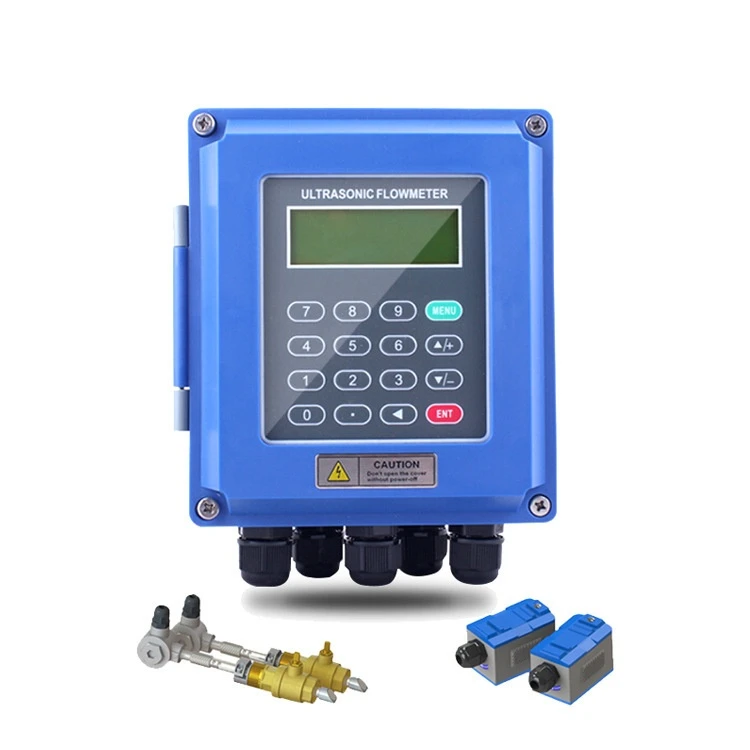
Ultrasonic Water Flow Meter
Turbine Digital Water Flow Meter
A turbine flow meter is a velocity-type flow meter. The turbine flow transmitter uses a multi-blade rotor (turbine) to sense the average water flow, then calculates the flow rate or totalized volume. This type of meter is best suited for clean, low-viscosity fluids and is widely used in high-accuracy applications such as petrochemical custody transfer, precision filling, and the measurement of clean water and light oils.
Differential Pressure Digital Water Flow Meter
A differential pressure (DP) flow meter calculates flow based on the pressure difference generated by a flow-sensing element installed in the pipeline, combined with known fluid properties and the geometric dimensions of the primary element and the pipe. It is suitable for high-pressure or high-temperature water flow measurement and is commonly used as an inline digital water flow meter.
Key Advantages
Extremely wide application range: To date, no other type of flow meter matches the versatility of differential pressure flow meters.
Orifice plate popularity: The orifice plate is the most widely used DP flow meter due to its robust structure, stable and reliable performance, and long service life.
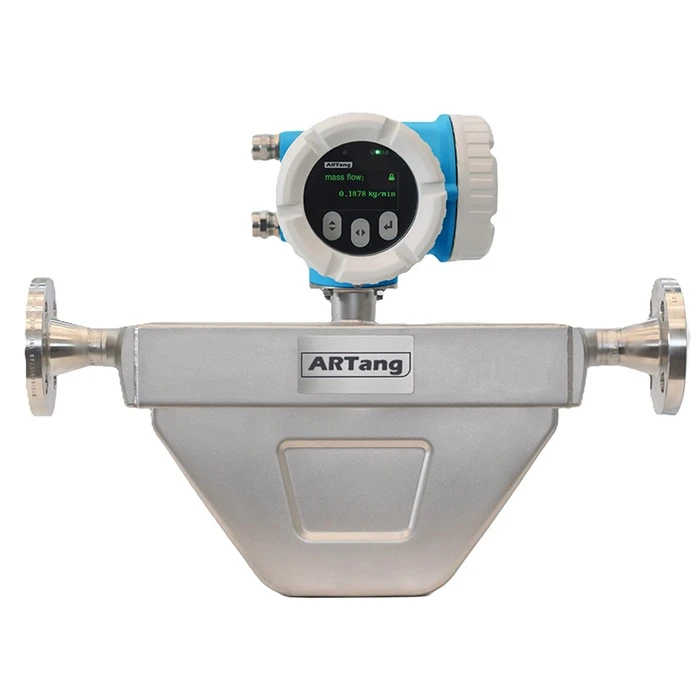
Coriolis Digital Water Flow Meter
A Coriolis mass flow meter is a direct mass flow measurement device based on the principle that the Coriolis force generated when a fluid flows through vibrating tubes is proportional to the mass flow rate. It is typically not the most economical solution for water measurement, but it offers extremely high accuracy—up to 0.1%. It can measure various types of water, drilling mud, slurry, pulp, sludge, and more, and is widely used as an inline digital water mass flow meter.
Key Features
Measurement accuracy of ±0.1% to ±0.5%, with some high-precision models achieving up to ±0.05%.
Suitable for slurries containing solid particles, non-Newtonian fluids (such as oil sludge and syrup), and multiphase flow applications.
Capable of measuring high-viscosity fluids (such as crude oil and polymers), high-pressure gases (such as CNG and LNG), and media with significant density variations (such as syrup and liquefied gases).
There are many types of digital water flow meters, each with its own ideal applications and advantages. Choosing the right flow meter can meet the accuracy requirements of different water flow measurement scenarios. Since every type has its strengths and limitations, understanding these characteristics is essential for selecting the most suitable flow meter.


