

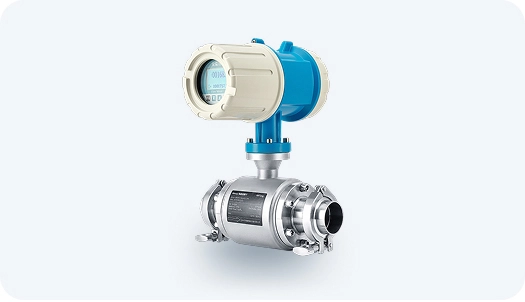

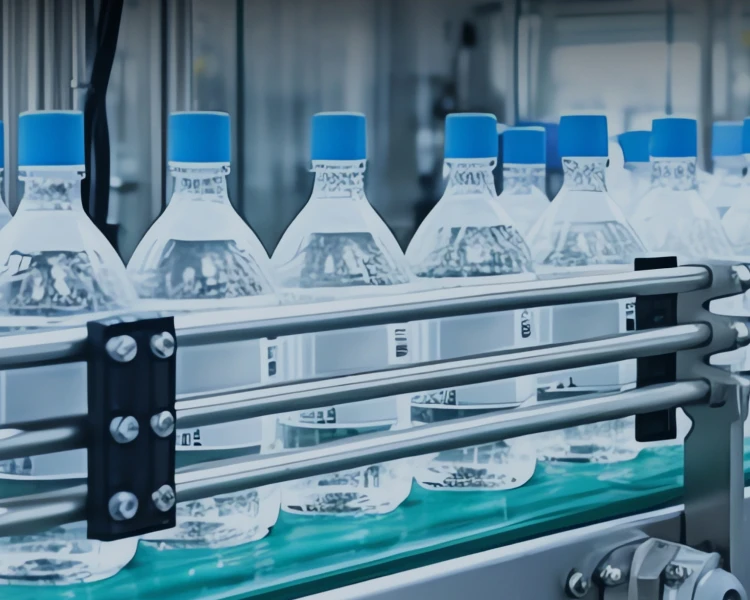


Food grade magnetic flow meters use new hygienic-grade liner materials and manufacturing processes that meet the sanitation requirements of the food industry. They also feature stainless-steel housings and stainless-steel clamp connections, allowing for quick disassembly and cleaning. This design helps prevent contamination during use and effectively avoids the buildup of fluid residue inside the measurement tube. These flow meters are widely used in the production of mineral water, soy sauce, jam, beer, juice, rice wine, milk, and other food products, as well as in sanitary and chemical applications.
Food Grade Magnetic Flow Meter: Hygienic Design for the Food Industry
Beer production requires extremely high hygiene standards, and the sanitary design of food grade magnetic flow meters must meet the following key criteria:
1. Material Compliance
Wetted parts: The measuring tube, electrodes, and liner must be made of food-grade materials. For example, 316L stainless steel—with its low carbon content (<0.03%)—effectively prevents intergranular corrosion and is typically certified by 3-A, EHEDG, or FDA. It ensures chemical compatibility with acidic or high-sugar wort.
Liner materials: PTFE (polytetrafluoroethylene) or PFA (perfluoroalkoxy resin) are preferred options. Their surface roughness (Ra < 0.4 μm) prevents microbial adhesion and withstands 140°C steam sterilization during CIP procedures.
Seals: Food-grade silicone or fluororubber is used to ensure reliable sealing, preventing wort leakage and blocking external contaminants from entering the system.
2. Hygienic Structural Design
Crevice-free construction: The inner surface of the measuring tube must be smooth and free of dead zones to avoid product retention. For example, DIN 32676 or ISO 2852 sanitary tri-clamp connections are used instead of traditional threaded joints, paired with EPDM gaskets for fully dead-zone-free cleaning.
Quick-release structure: The sensor and transmitter are typically designed as separate units, allowing fast disassembly and maintenance in high-temperature sanitation environments. They also support digital communication protocols such as HART or PROFIBUS-PA.
Electrode design: Flush-mounted electrodes (such as capacitive electrodes) are preferred to avoid material buildup. For high-viscosity fluids (such as mash), removable scraper electrodes can be used to mechanically clean and prevent scaling.
3. Protection Rating and Cleaning Compatibility
Protection Rating: The meter must meet the IP69K standard to withstand high-pressure wash-downs and prevent moisture intrusion that could cause circuit failure.
Cleaning Compatibility: It must support CIP/SIP (Clean-in-Place/Sterilize-in-Place) processes. The measuring tube materials must withstand temperatures up to 140°C and resist alkaline cleaning agents. Surface treatments such as electropolishing can further improve cleanability.
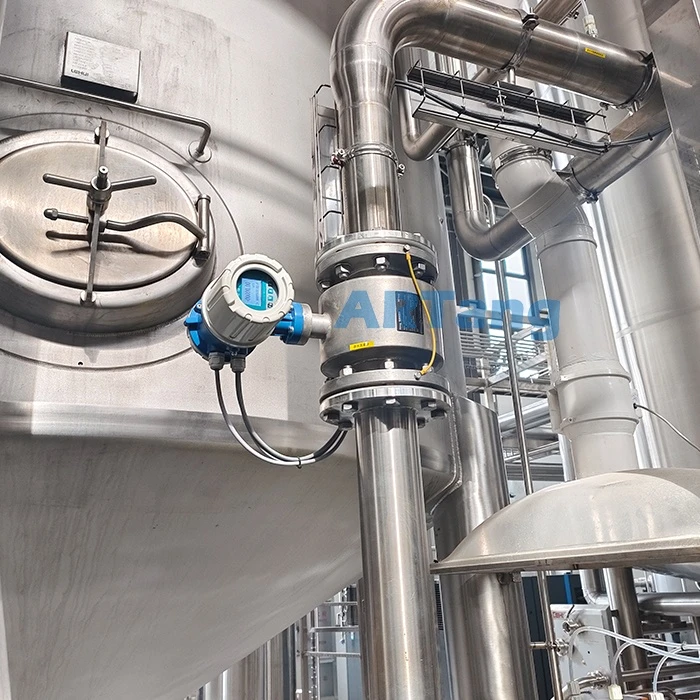
Magnetic Flow Meters for Brewery
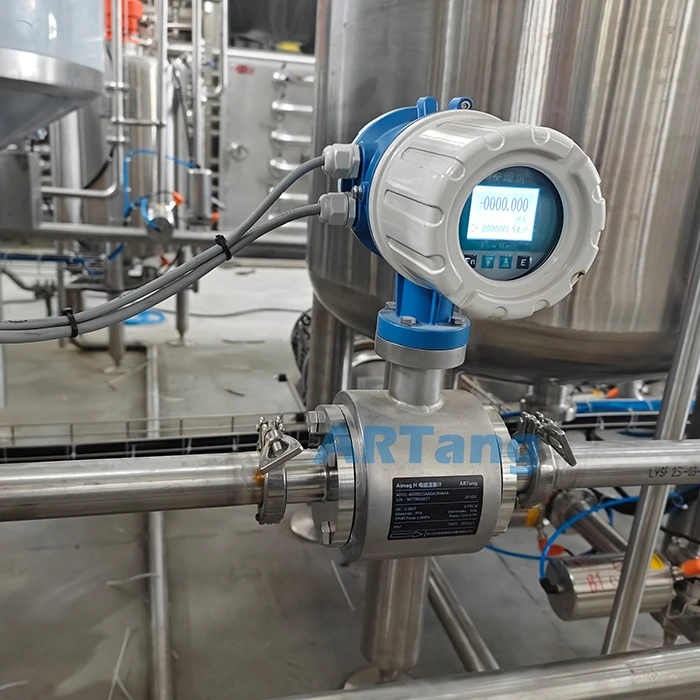
Flowmeter for Food and Beverage
Matching Malt Wort Characteristics to Process Requirements
In beer production, the physical properties of wort—such as conductivity, viscosity, and temperature—create specific requirements for selecting a suitable magnetic flow meter.
1. Conductivity Requirements
Wort typically has a conductivity above 5 μS/cm, which meets the basic measurement threshold for magnetic flow meters. However, if non-conductive additives (such as certain stabilizers) are used, conductivity may drop. In these cases, low-frequency rectangular-wave excitation should be selected. This alternating field reduces electrode polarization and ensures stable measurement.
2. Viscosity and Flow Velocity Control
High-viscosity wort (such as mash liquid in the later saccharification stage) may introduce measurement noise. Solutions include:
Increasing the pipe diameter (≥ DN50) to reduce flow velocity and turbulence
Using low-frequency excitation (e.g., 6.25 Hz square wave) to suppress noise interference
Enabling self-diagnostic functions to continuously monitor electrode conditions and alert operators to scaling or fouling risks
3. Temperature and Pressure Compensation
During mashing (65–72°C) and boiling (100–105°C), wort experiences significant temperature variations. A meter with temperature compensation ensures accurate readings across a wide range—from -10°C to 130°C.
Additionally, the pressure rating should exceed 1.5× the maximum operating pressure to withstand pump-induced pressure fluctuations during the brewing process.
Closed-Loop Management from Design to Certification
The compliance of food-grade magnetic flow meters requires multi-dimensional verification:
Material Certification: 316L stainless steel must be supported by material test reports, and PTFE liners must be certified under FDA 21 CFR Part 177.1550.
Sanitary Certification: Must meet the requirements of EHEDG Doc 8 or 3-A Sanitary Standards 74-03.
Functional Testing: Accuracy and stability must be verified by simulating wort conditions, including variations in conductivity and viscosity.
Data Traceability: Equipped with FDA 21 CFR Part 11–compliant data recording functions, supporting batch measurement modes to meet traceability and audit requirements.
The application of food-grade magnetic flow meters in wort measurement is essentially a deep integration of Faraday’s law of electromagnetic induction and sanitary design principles. From material selection to structural optimization, from conductivity adaptation to temperature compensation, every technical detail must revolve around the core requirements of precision, stability, and hygiene.
As the brewing industry continues to pursue smarter and greener production, the sanitary design of magnetic flow meters will further evolve toward modularity and self-cleaning capabilities, providing more reliable technical support for process control.


